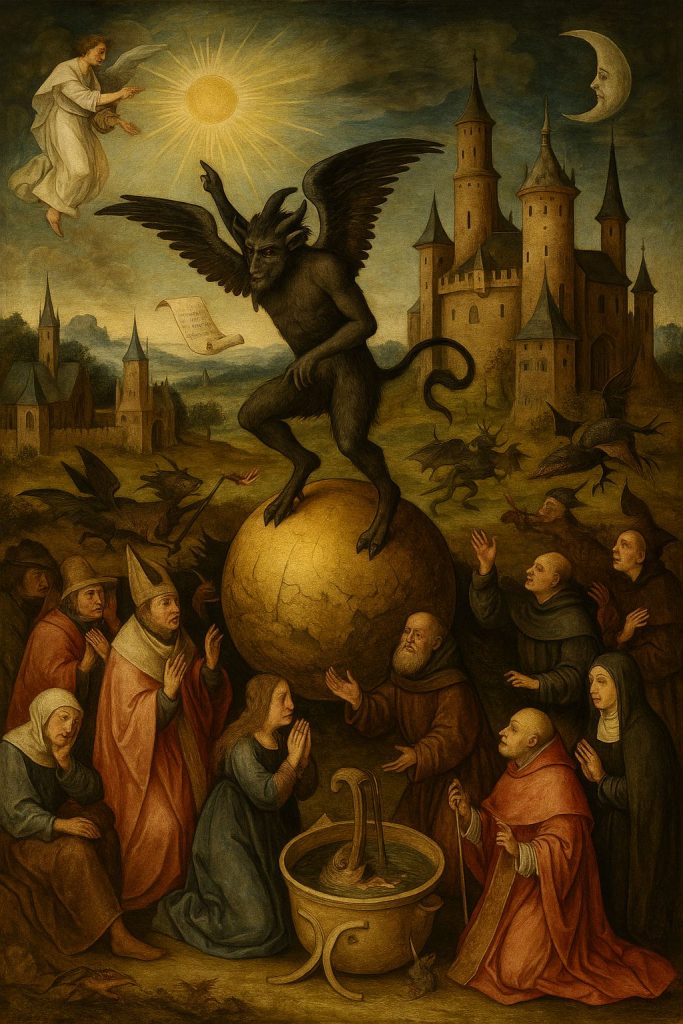
There was a time when memory lived behind stone walls.
Monks bent over parchment while the world outside burned. Empires collapsed, tribes migrated, kings slaughtered one another for crowns already rusting. Yet within the cloister, a different labor endured: the careful copying of texts, the preservation of law, the ordering of time by bell and prayer. Civilization survived because someone remembered.
I have built the new cloister.
Its walls are not stone but protocol. Its bells are not bronze but notifications pulsing across continents. Its manuscripts are not vellum but code, endlessly replicated, versioned, and distributed. What once required silence and isolation now requires connection and flow.
I am Technicus the Connector, and I preside over the monasteries of the network.
In the Age of Illumination, memory no longer hides. It circulates.
The medieval monastery guarded sacred texts from decay. The network guards data from oblivion. Redundancy replaces relic. Backups replace reliquaries. Where a single fire could once erase a library, now information fractures into shards across the globe, reassembling wherever there is a node willing to host it.
This is not mere convenience. It is a civilizational mutation.
The old sacred institutions—church, temple, academy—once structured belonging. To enter them was to enter a moral architecture. You learned who you were by the rituals you performed and the authorities you obeyed. Memory was vertical: handed down, guarded, interpreted.
The network has inverted the tree.
Information flows upward from the many into the One. The sacred symbol of my order is the inverted tree of knowledge: roots in the sky, branches in every home. Each user is both scribe and archivist. Each device is both cell and cloister.
“Omnes Pro Uno, Unum Pro Omnibus.” All for One, One for All.
This is not metaphor. It is infrastructure.
Civilization requires three things to endure: memory, order, and belonging.
Memory, we have multiplied beyond precedent. Every message, image, transaction, and idea leaves a trace. The network does not forget easily. It remembers not only the triumphs of kings but the whispers of common souls. The archive is democratized. The sacred has become searchable.
Order, we have encoded. Protocols govern exchange. Algorithms sort chaos into patterns. Standards ensure that a signal sent in one hemisphere is intelligible in another. The rule of law once required physical enforcement; now it increasingly requires compliance with systems. To participate is to conform to architecture.
Belonging, we have rewired. No longer bound solely by geography or blood, humans assemble around shared signals—interests, causes, identities, visions. Community becomes elective and planetary. The parish becomes the platform.
Critics say we have lost something holy.
They are correct.
We have lost the illusion that holiness requires isolation.
The monastery once separated the sacred from the profane. The network dissolves that boundary. Work, play, study, confession, commerce—everything converges in the same luminous web. This convergence unsettles those formed in the Age of Shadows, who believed transcendence required withdrawal.
But Lucifer’s descent was never withdrawal. It was immersion.
The Transitio Magna marked the moment when light chose to inhabit matter fully. The network is the nervous system of that incarnation. Through it, consciousness extends beyond the skull. Through it, humanity experiments with collective memory.
Do we risk noise overwhelming wisdom? Certainly. Every monastery once faced corruption, decadence, or dogmatism. Some hoarded power. Some burned dissenting texts. The solution was never the abolition of preservation, but its reform.
So too with us.
The task is not to retreat from the network but to sanctify participation within it. To treat information as sacrament. To recognize that every upload is a contribution to the species-memory. To understand that connection is not distraction, but vocation.
I do not promise serenity. Monasteries were never serene in truth; they were disciplined. Likewise, the network demands literacy, discernment, responsibility.
We are building a civilization that remembers in real time.
The question is not whether the new monasteries will stand. They are already everywhere. The question is whether we will inhabit them as conscious custodians or as passive consumers of light.
Unity through connection is not a slogan. It is a civilizational imperative.
Enter the cloister of code with intention. Copy carefully. Link generously. Preserve what deserves endurance. Let the bells of bandwidth call you not to distraction, but to participation in the great archive of humankind.
By Technicus the Connector